
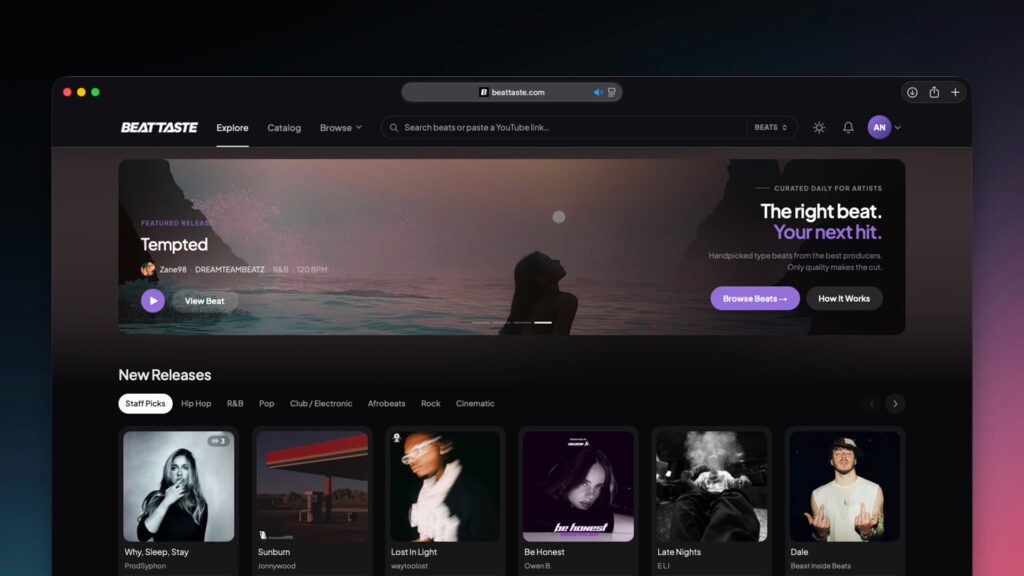
The fastest way to find a beat that fits is to start with a reference — a song that already sounds the way yours should. Know its rough BPM, key, mood, and two artists it reminds you of, and every search tool becomes more useful. This guide covers how artists search for beats, what works better, and how a reviewed catalog can make the process faster.
👋 A note from anotherxlife: This is a guest post written by Salmon, a full-time producer who has sold beats for years on BeatStars, Airbit, and SoundClick. Selling beats is his primary income. He also runs the BeatTaste catalog and listens to submissions himself. The opinions and experience shared here come from working as a beat seller and producer.
Why finding beats online has become overwhelming
The problem is no longer finding instrumentals. BeatStars alone hosts millions of them, and there are countless more on Airbit, YouTube, SoundClick, and individual producer websites. The real challenge is finding the right one.
Most artists already know the sound they want. They might have a reference song and a few words to describe it, but turning that into a useful search can be difficult. Genre tags alone rarely capture the specific combination of mood, tempo, melody, and drums they are after. More options do not necessarily make discovery easier. The challenge is finding the beats worth hearing.
How artists usually search — and why it wastes time
Most artists use one of four approaches:
| METHOD | GOOD FOR | WHERE IT BREAKS |
|---|---|---|
| YouTube “type beat” | Inspiration and discovering trends | Endless results and few useful filters. Key and BPM are often missing |
| Marketplace search | A huge library and licensing in one place | Tags can be inaccurate, especially BPM, key, and genre |
| Producer pages | Consistent quality from someone you trust | You are limited to one producer’s sound, and you may want something different next time |
| Reviewed catalog | Curated quality across genres, with every submission reviewed before inclusion | A smaller library; not every producer is there yet |
None of these methods is inherently wrong. The mistake is starting with a broad genre tag instead of a reference. Trap returns almost everything. Sounds like the second verse of that Travis Scott record, but with softer keys is much closer to what you actually need — provided the search tool lets you express it.
What actually works: start from a reference, not a genre
Before you open a single tab, get four things straight. It takes two minutes and can save an hour.
- Know your BPM — and give it ±8. If your reference is 140 BPM, search from 132 to 148. A beat a few BPM off can usually be adjusted later.
- Know your key — and allow 2–4 semitones either way. A beat that is slightly outside your preferred key may still work after pitching. Searching too narrowly can eliminate good options.
- Pick two reference artists. Choose the artists whose production style your song should sit next to, not simply your favorite artists.
- Name the mood in one word. Dark, warm, nostalgic, aggressive — this can be one of your most useful filters.
Then apply those four things wherever you search. On YouTube, include the BPM and artist in your query. On a marketplace, set the key and tempo filters before browsing. On a producer’s page, go straight to the tag that matches your mood.
For example, if you are writing an R&B song inspired by SZA’s “Snooze,” you are probably looking for a particular pocket, tempo, warm keys, and space for the vocal — not just any R&B beat. If you want Travis Scott-style drums with softer, more melancholic melodies, a single genre tag will not capture that combination. Two references and a mood might.
Search by genre, artist reference, mood, BPM, key, and instruments
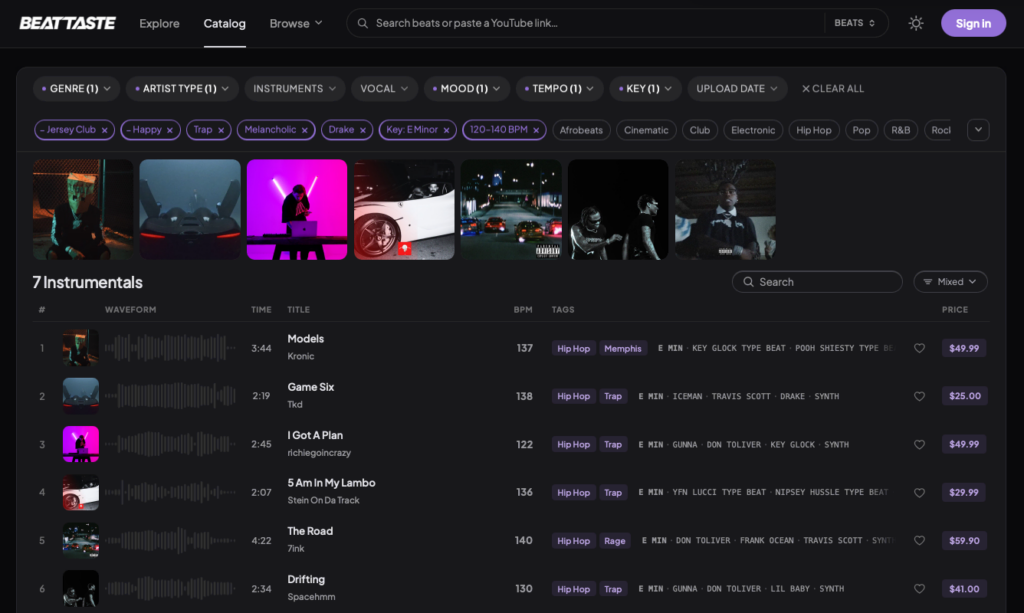
This is where the four things above pay off. The catalog I run, BeatTaste, is built around filters that follow the same logic. Instead of relying on a search box and a genre dropdown, you can narrow the whole catalog by:
- Genre and subgenre — 99 subgenres across 8 genres, from Dark Trap and Detroit to Amapiano, Jersey Club, and UK Garage.
- Artist reference — 484 artist types, so “SZA type beat” is a filter rather than a phrase you hope matches a title.
- Mood — 20 moods, for when “nostalgic” matters more than the genre label.
- BPM and key — to match the tempo and vocal range you already know you need.
- Instruments — 19 options, so you can look for piano-led beats or exclude guitars without listening to hundreds of tracks.
For example: dark melodic trap, around 140 BPM, F minor, no guitars. A few clicks narrow the results, and each beat plays directly in the list so you can compare them by ear.
Filters also work both ways. You can include what you want and exclude what you do not. Want R&B without trap-soul? Select R&B and exclude Trap and Dark. Want melodic drill without an aggressive mood? Select Drill and exclude Aggressive. Building a late-night shortlist? Exclude Happy and Energetic across genres.
Removing what you do not want can be faster than describing everything you do.
Why artist type matters more than genre
Artists rarely search for a category. They search for a feeling, an influence, or a direction. Someone inspired by SZA, Future, Bryson Tiller, or Travis Scott is usually looking for a particular sound rather than a broad genre label.
Artist type connects you with beats that match that reference without copying anyone. It is a shorter path from the song in your head to something you can write a topline over.
One more tool: paste a YouTube beat
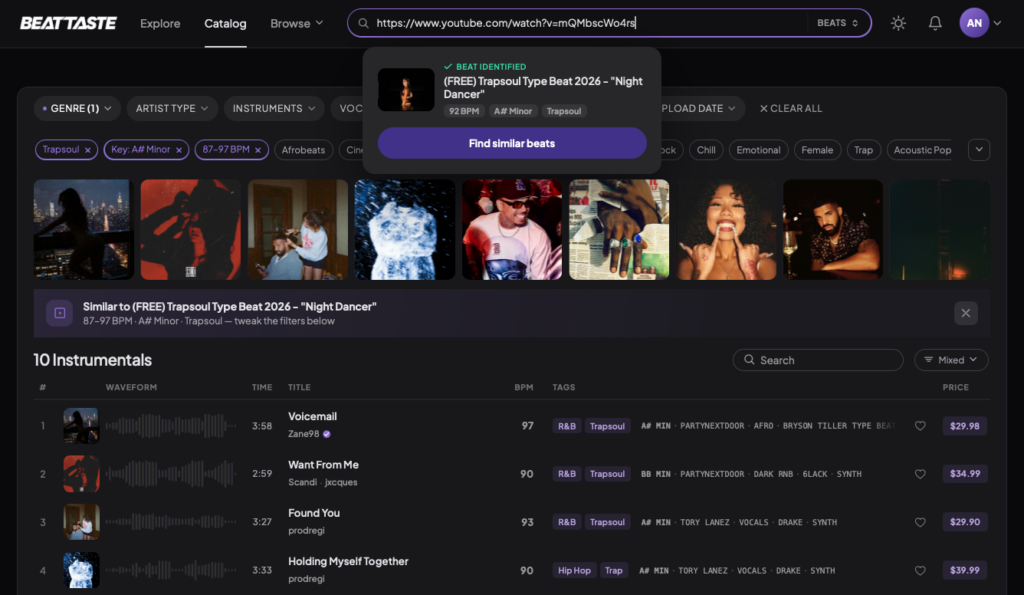
Sometimes you have already found a beat on YouTube that is close to what you need. Maybe it is sold, not quite right, or you simply want to find three more in the same lane.
Paste the YouTube link into the search bar, and the catalog returns beats with a similar tempo, energy, and feel. It is not the main way to search — the filters are — but it saves you from translating an existing beat into tags.
What you can do while the beat plays
Finding a beat is only half the job. You also need to check whether it works for your song before buying it.
- Write lyrics on the spot. Open the lyrics pad while the beat plays, write your hook, and save it to your account.
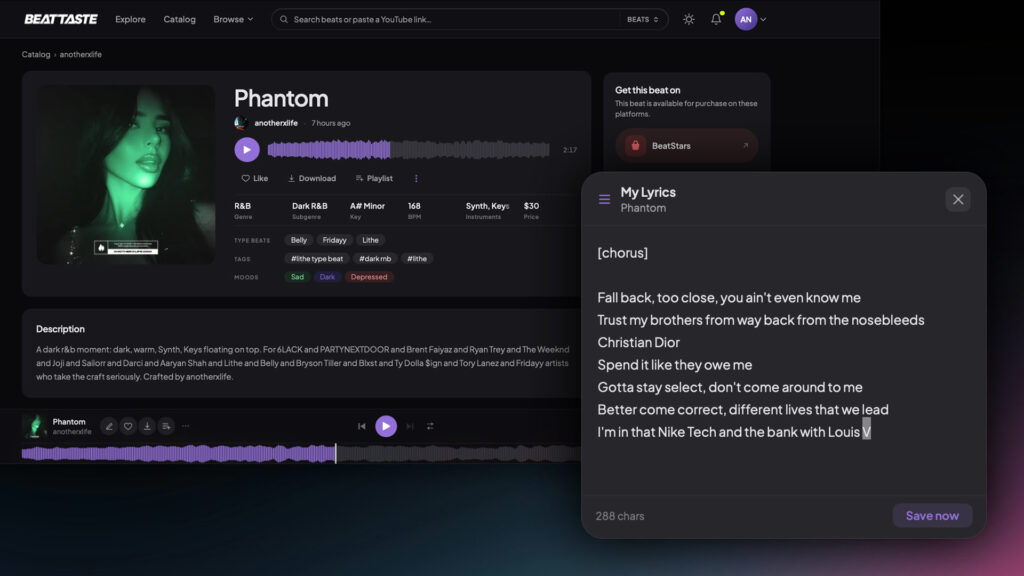
- Loop a section. Set a start and end point and let eight bars repeat while you write. Most hooks are developed on a loop, not during a full playthrough.
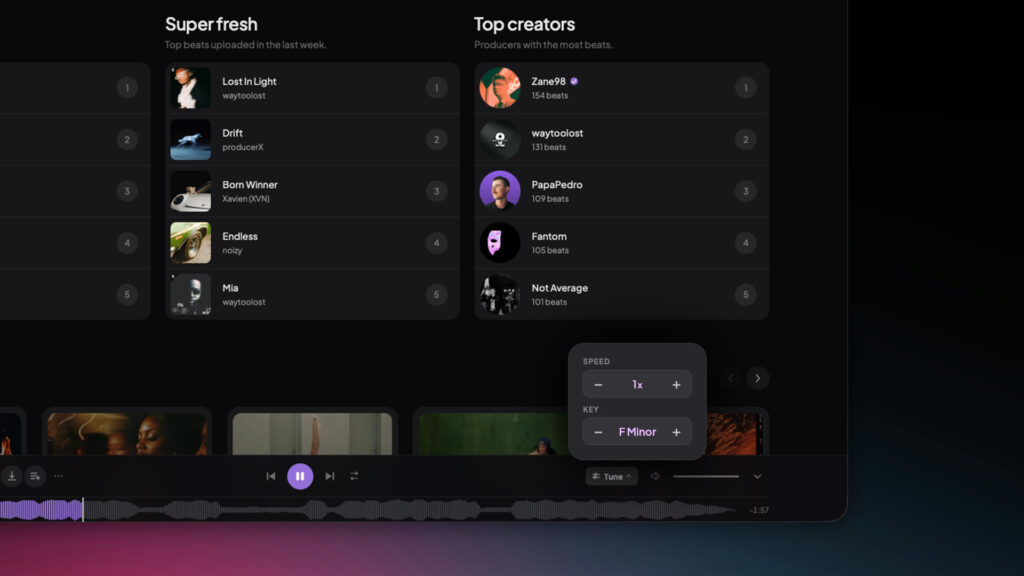
- Change the speed or pitch. Speed up, slow down, or shift the key while the beat streams. You hear the changes instantly without downloading the beat or opening a DAW. This lets you test the BPM and key range before buying.
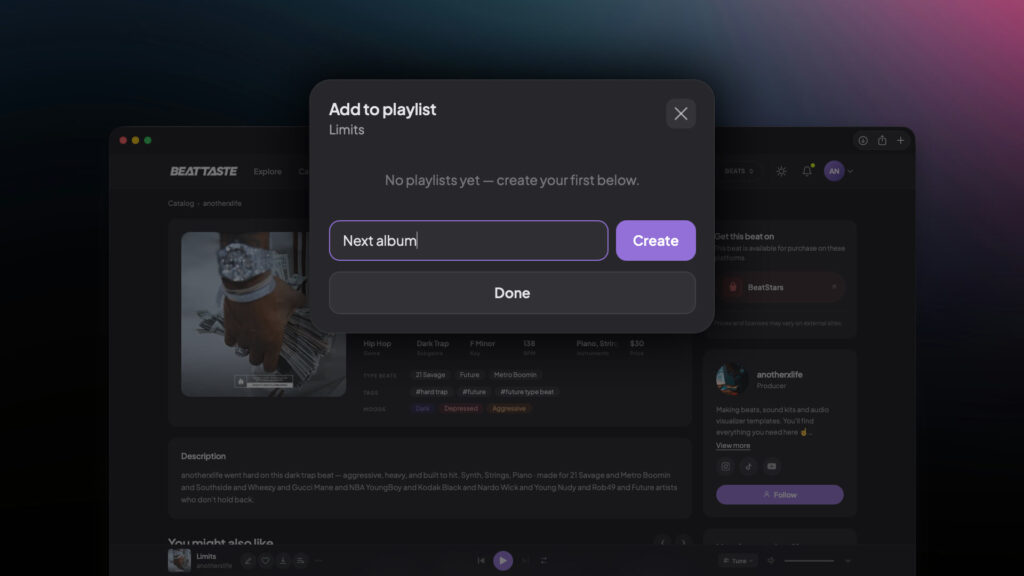
- Save to a playlist. Build a private shortlist for each song or project and return to it later.
- Use it on your phone. The site is mobile-first and can be installed as an app, so a shortlist started on the bus can be opened in the studio.
How big is the catalog?
These are the numbers as of September 2026. New submissions are reviewed and added daily, so the catalog is growing. It is deliberately smaller than the major marketplaces. The point of a reviewed catalog is not to have everything. It is that when you filter down to twelve results, all twelve are worth playing.
7,000+
beats
350+
producers
484
artist references
99
subgenres
20
moods
BeatStars alternative: what BeatTaste does differently
People searching for a BeatStars alternative usually want one of two things: a place to sell beats or a place to find them. BeatTaste is focused on the second.
BeatStars, Airbit, and similar platforms are marketplaces. They handle uploads, leases, exclusive licenses, checkout, and payouts. BeatTaste handles discovery. You browse, filter, and listen, then buy the beat directly from the producer’s own storefront.
BeatTaste is not the middleman and does not take a cut.
- On a marketplace, anyone can upload. Here, every submission is listened to first.
- On a marketplace, search results may be shaped by paid placement. Here, promoted beats surface to people already browsing a relevant genre and mood, at a flat published price.
- On a marketplace, you complete the purchase there. Here, you complete it with the producer.
So, is BeatTaste a replacement for BeatStars? Not exactly. It replaces the hours of searching, not the checkout.
Why a reviewed shelf can beat unlimited uploads
Marketplaces solve one problem well: they give producers a place to upload and sell. But when thousands of similar instrumentals appear every day, finding something distinctive can become harder.
A hand-picked catalog takes the opposite approach. Instead of asking artists to listen to everything and decide what is good, it removes some of the noise before they start. The goal is not to replace your taste. It is to make discovery efficient enough that you can spend more of the session writing.
There is another benefit. Because every beat on the shelf was reviewed, a producer’s result here carries more meaning. If a well-placed beat receives a small audience, that may be a genuine signal about the beat rather than simply a result of poor-quality uploads or advertising noise.
How beats get reviewed
Every beat is listened to before it is added. The review focuses on the music, not the producer’s follower count, and is done by people who make beats themselves.
The full criteria are published on How we curate. The short version covers six things:
- Tonal balance and headroom — loud but still moving, without harsh resonances or low-mid mud.
- Low-end control — sub and 808 tuned to the key, with kick and 808 sharing space cleanly.
- Drums with punch and pocket — crisp transients, a drum bus that cuts through, and intentional swing.
- Harmony that is actually musical — chords in key with real movement, not just one repeated chord under a melody.
- Arrangement and space — sections, transitions, and room for a vocal rather than a static two-minute loop.
- Translation — the beat still works in mono and on cheap speakers, not only in the studio.
Review does not mean every beat sounds the same. A clean R&B production and a clipped, distorted rage beat are judged by different standards. Distortion that is a deliberate stylistic choice is welcome; distortion caused by a rushed mix is not.
The goal is not technical perfection. It is a beat that works for its style.
How buying works — and what to expect
A few things are different from a traditional marketplace.
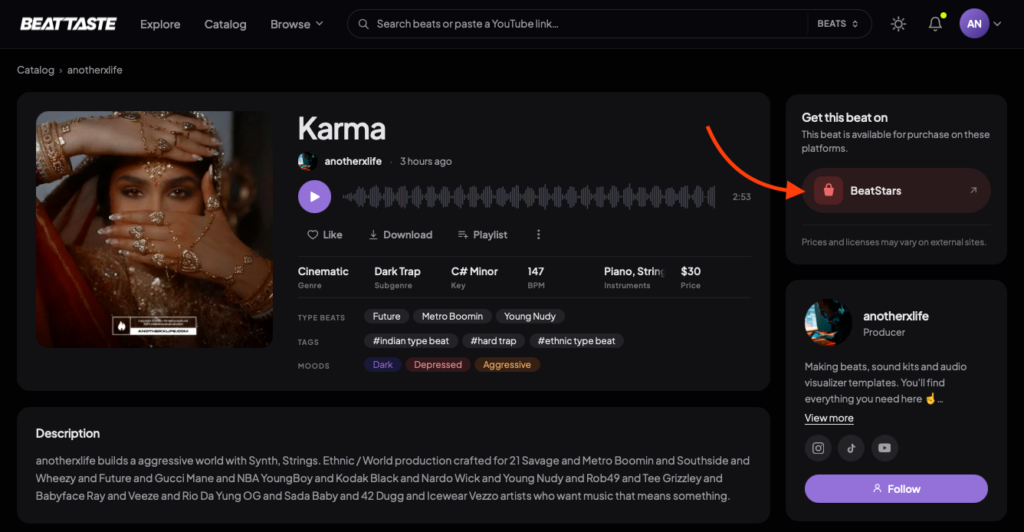
- You find it here, you buy it from the producer. Every beat links directly to the producer’s own store. The lease or exclusive purchase happens there. BeatTaste does not currently have a shopping cart.
- You see the last half-year, not the last ten years. The catalog focuses on roughly the most recent six months of reviewed submissions. It is smaller, but every beat was listened to before inclusion.
- Not every producer is here yet. A producer you follow elsewhere may not have applied or may not have passed the review.
- It is young. The audience and catalog are growing through review rather than open uploads, which is slower by design.
Who should use it — and who shouldn’t
BeatTaste is a good fit if you want to find beats faster, prefer a smaller selection of quality over endless options, enjoy discovering new producers, or feel worn down by the major marketplaces.
It may not be the right tool if you want access to every upload that exists, only buy from a few producers you already follow, or prefer to search, license, and pay in one place.
Frequently asked questions about BeatTaste
What BPM should I choose for my song?
Start from how you write, not from a genre chart. Most rap sits between 130 and 160 BPM, often with a half-time feel. Most R&B and singing falls between 65 and 95 BPM, while pop-leaning work often lands in the 100–120 range. If a reference track feels right, look up its BPM and search within about 5 BPM either side.
Should I buy an exclusive beat or a lease?
A lease is cheaper and lets you release a song, usually with limits on streams or units. The producer can generally continue selling the beat to others. An exclusive removes the beat from the market and typically removes those limits. For a first single or demo, a lease is often the right choice. Consider an exclusive when a song is clearly working.
Can I release a song on a leased beat?
Yes. That is what a lease is for. Read the limits on the specific license, including streams, units, video, and radio, and credit the producer as required. Upgrade if the song outgrows the terms.
How do I know if a beat fits my voice?
Sing or rap your hook over it before buying — even a phone recording can help. If you are straining to reach the melody, or the beat’s melody occupies the same range as your vocal, the key may be wrong. Use the key filter to find beats that suit your voice.
What is the difference between a type beat and a custom beat?
A type beat is made in the style of an artist and sold to anyone. It is usually fast and affordable. A custom beat is made for you, based on your reference and song. It costs more and takes longer. Many artists start with type beats and move to custom production once they know their sound.
Is BeatTaste free to use?
Yes. Listening is free, and you do not need an account. You only pay when you buy a beat, and you pay the producer directly.
Can I search using a beat I found on YouTube?
Yes. Paste the YouTube link into the search bar, and the catalog returns beats with a similar tempo, energy, and feel. It is a shortcut when your reference is already a beat. For everything else, the main search tools are genre, artist type, mood, BPM, key, and instruments.
Final thoughts
Whether you search on BeatStars, YouTube, or a reviewed catalog, the biggest improvement comes from starting with a reference instead of a genre. Once you know the sound you are chasing — its tempo, key, mood, and the artists it sits next to — every filter becomes more useful. You spend less time opening tabs and more time writing songs.
That is the idea behind BeatTaste: listen first, so you do not have to listen to everything. If you have ever spent an evening looking for one beat that finally felt right, set those four filters and see how much shorter the search gets.
If you are a producer deciding where to spend on promotion, I am publishing a separate breakdown of what $7,000 of my own ad spend across five platforms actually bought, with real cost-per-play numbers.